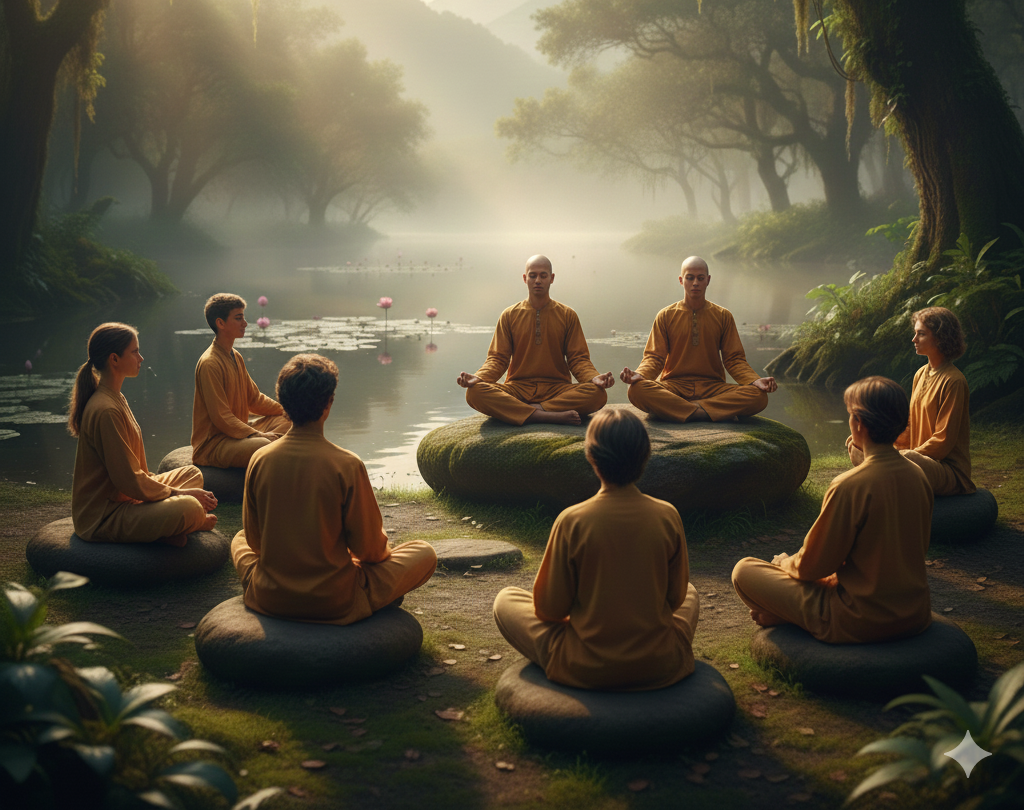
Some days, it feels like the world is overflowing with noise. Messages ping, tasks pile up, and everyone seems to want a piece of your time. In the middle of all that chaos, something gentle awakens inside — not a desire for more, but for less. Less clutter, less rushing, less overwhelm. Just a quiet space where peace can finally breathe.
You might have felt it — that yearning to simply sit, to breathe, to feel life without needing to fix or achieve anything. It’s as if something deep inside remembers what calm feels like. That memory, that pull inward, is the beginning of Dhyana — the ancient art of stillness.
Dhyana isn’t just about closing your eyes and trying to empty your mind. It’s about entering a relationship with silence, where awareness becomes your teacher. In that silence, the constant hum of thoughts begins to fade, and something extraordinary emerges: a sense of wholeness that was never truly lost, only forgotten.
In today’s restless world, inner peace can seem impossible — like trying to still the wind. Yet the ancient yogis taught that peace isn’t something we must find; it’s something we must remember. It already exists beneath the surface of our thoughts, waiting patiently for us to stop searching outside and turn inward.
The journey of Dhyana is not a spiritual luxury; it is a human necessity. It’s how we return home to ourselves, how we touch the quiet center from which all clarity and love arise.
This article invites you to take that first gentle step. You don’t need experience or faith — only curiosity and sincerity. Let’s walk together through the understanding, challenges, wisdom, and practices of Dhyana. And by the end, may you not only know peace but feel it moving through your breath.
Take a slow breath. The journey begins now.
The word Dhyana comes from the Sanskrit root dhi, meaning “contemplation” or “profound thought.” It is the seventh limb of Ashtanga Yoga, described by Sage Patanjali in the Yoga Sutras. Before one reaches Dhyana, there is Dharana — concentration, or holding the mind steady on one object. When that concentration flows continuously and effortlessly, it becomes Dhyana.
In essence, Dhyana is meditation — not as an act, but as a state of being. It’s when the distinction between the observer, the process of observing, and the observed begins to fade. Awareness becomes seamless, like a river merging with the sea.
To put it in modern terms, Dhyana is the brain’s shift from scattered thinking (beta waves) to calm, coherent awareness (alpha and theta waves). This state has been shown through neuroscience to enhance emotional balance, memory, and creativity while reducing anxiety and stress.
But Dhyana goes beyond what science can measure. It is not merely about calming the nervous system but awakening consciousness itself — the silent awareness that observes thoughts without getting caught in them.
When you practice Dhyana, you begin to see the difference between your mind and your awareness. The mind chatters; awareness listens. The mind judges; awareness accepts. The mind fluctuates; awareness remains still. That stillness is peace.
Understanding this is the beginning of your Dhyana journey. It’s not about controlling thoughts, but about relaxing into awareness — allowing your inner sky to clear naturally as clouds of thought drift by.
The first challenge of Dhyana arises the moment we sit down. The body may be still, but the mind races on. Thoughts appear like a restless crowd — memories, plans, fragments of emotion. You may wonder: Am I doing this right? Why can’t I quiet my mind?
The truth is, everyone faces this struggle. The human mind was designed to think; expecting it to be silent instantly is like asking the ocean not to wave. The goal of Dhyana is not to suppress thoughts but to stop identifying with them.
The restless mind is not your enemy — it’s your teacher. Each distraction reveals your habitual attachments: fears, desires, worries. Observing them without reaction begins the process of release.
From a psychological view, the mind resists stillness because it is addicted to stimulation. The brain’s dopamine system, accustomed to novelty and reward, feels uneasy when deprived of mental activity. But with regular practice, new neural patterns form — ones that associate calm with safety instead of boredom.
Emotionally, this process can surface old wounds or hidden anxieties. But this too is healing. In Dhyana, suppressed emotions rise only to dissolve in awareness. Like clouds clearing after rain, the mind becomes transparent once more.
The greatest mistake beginners make is judging their practice. There is no “good” or “bad” meditation. Every session — busy or quiet — serves a purpose. What matters is sincerity and consistency.
When you notice the mind wandering, gently bring it back to the breath. That simple act of returning is Dhyana in motion — awareness remembering itself again and again. Over time, the struggle softens into a rhythm, and stillness begins to feel like home.
In the ancient Indian spiritual tradition, Dhyana was seen as the sacred bridge between the self and the infinite. The Upanishads speak of meditation as the means through which the Atman (individual soul) realizes its unity with Brahman (universal consciousness).
The Katha Upanishad says: “When the five senses and the mind are still, and reason itself rests in silence, then begins the highest path.” This describes Dhyana perfectly — a state beyond thought where awareness turns inward, illuminated by its own light.
The Bhagavad Gita also offers a deeply practical vision of meditation. Lord Krishna advises: “Let a person find a place of solitude, sit firm and alone, with the mind controlled and thoughts subdued, seeking peace in the Self.”
In Buddhism, this same principle evolved into Dhyana (Pali: Jhana), leading ultimately to enlightenment (Nirvana). The Buddha taught that through sustained meditation, one perceives reality as impermanent and empty of ego — freeing the mind from suffering.
Interestingly, the word Dhyana traveled across Asia: in China, it became Chan; in Japan, Zen. Each culture added its own flavor, but the essence remained — the art of effortless awareness.
Modern science now validates what these sages knew intuitively. Brain imaging of advanced meditators shows profound synchronization between the hemispheres — what yogic philosophy called union, or Yoga. Heart-rate variability studies show that deep meditation aligns the rhythm of the heart with the rhythm of the breath — the pranic flow of life.
Thus, Dhyana is both ancient and timeless. It is not bound by religion or ritual. It is the natural flowering of consciousness — the moment the seeker and the sought become one.
Here are a few simple, science-backed yet spiritually grounded ways to begin your Dhyana journey:
1. Prepare the Space
Choose a quiet, comfortable spot. Sit on a cushion or chair with your spine erect but relaxed. Lighting a small lamp or candle can help create a sacred, calm atmosphere.
2. Anchor with Breath
Begin by observing your natural breath. Feel the coolness as you inhale, the warmth as you exhale. Let the breath be your guide — the thread that brings the wandering mind back home.
3. Witness the Mind
Thoughts will arise — let them. Watch them as clouds drifting through the sky of your awareness. Do not analyze, do not resist. Simply observe.
4. Move from Dharana to Dhyana
After focusing on the breath (Dharana), gradually let go of the effort. Allow your attention to expand and merge with awareness itself. This effortless flow is Dhyana.
5. Close with Gratitude
Before opening your eyes, rest a few moments in gratitude — for the breath, for awareness, for this moment. Gratitude stabilizes peace in the nervous system and opens the heart.
Practicing even 10–15 minutes daily can rewire your brain for calm. Over weeks, you’ll notice subtle changes — deeper sleep, softer emotions, greater clarity. But the real gift of Dhyana is inner space — the freedom to respond rather than react, to live consciously rather than automatically.
The path of Dhyana is not about escaping life but embracing it from a deeper stillness. It’s about realizing that peace is not the absence of chaos but the presence of awareness amid it.
As your journey unfolds, you’ll begin to sense peace not as an experience but as your very nature. Situations may still challenge you, but your response will change. Like a mountain that remains unmoved by passing clouds, your awareness will stay centered.
Remember, Dhyana is not a destination but a rhythm — the ebb and flow of attention returning home to silence. Some days will feel easy; others, restless. Both are part of the same music.
When frustration arises, smile gently. Even that feeling is an invitation to observe. When stillness comes, don’t cling to it — simply be. Over time, you’ll find that peace is not something you reach in meditation; it’s something you bring into every breath, every conversation, every act of living.
As the Mandukya Upanishad beautifully puts it: “The Self is peace. The Self is bliss. The Self is all.”
So, take one conscious breath now. Feel it enter, feel it leave. Between those two moments lies eternity — quiet, awake, infinite. That is Dhyana. That is peace.
#Dhyana #InnerPeace #Mindfulness #YogaJourney #MeditationPractice