There are moments in life when the world quiets down — just for a breath — and something inside us feels profoundly still. It might happen while gazing at the ocean, during a deep sigh after a long day, or in the space between thoughts as you drift to sleep. That silence, however brief, carries a flavor of peace we spend lifetimes searching for.
In ancient India, the sages called that inner stillness Dhyana — a state of meditation where awareness merges into itself. Not the act of meditating, but the being of meditation.
Today, our minds are constantly pulled outward — into screens, deadlines, and conversations. We live in a world that celebrates speed but quietly starves for silence. Yet beneath the rush, there remains an ancient call to return — to remember the sanctuary within.
Dhyana is not about escaping the world, but seeing it with unclouded awareness. It is the art of diving beneath the surface waves of thought into the calm depths of being. In that depth, the constant chatter of the mind fades, and a quiet intelligence begins to speak — not in words, but in presence.
Meditation, in this sense, is not something we “do”; it is something we remember. It is our natural state, veiled by constant thinking. The journey of Dhyana is a journey back to that remembrance.
This article invites you to dive deeper into that exploration — to understand what Dhyana truly means, the challenges of reaching it, the wisdom of the ancients, and how you can cultivate it in your daily life.
Take a breath. Feel it enter, feel it leave. That is where the journey begins.
The Sanskrit word Dhyana comes from the root dhi, meaning “to perceive” or “to contemplate.” In the Yoga Sutras of Patanjali, Dhyana is the seventh limb of Ashtanga Yoga — the Eightfold Path. It follows Dharana (concentration) and leads to Samadhi (union or enlightenment).
To understand Dhyana, imagine focusing on a candle flame. In Dharana, you hold your attention on it with effort. In Dhyana, the effort dissolves. Awareness flows naturally toward the flame — there is no separation between the observer and the observed. It is meditation without the meditator.
From a scientific perspective, Dhyana corresponds to a highly coherent state of brain activity. EEG studies of advanced meditators show synchronized alpha and theta waves — indicators of relaxed yet alert awareness. The prefrontal cortex (responsible for focus) quiets down, and the limbic system (responsible for emotions) stabilizes. This neurological balance mirrors the inner equilibrium described in yogic texts.
In everyday terms, Dhyana is when your awareness becomes continuous, when you’re no longer pulled into thoughts but remain steady in presence. It’s not about erasing the mind but transcending identification with it.
Patanjali explains: “When meditation is continuous, like the flow of oil, it becomes Dhyana.” This metaphor captures the essence perfectly — a smooth, unbroken stream of attention.
At its heart, Dhyana is the bridge between self and Self, between the restless surface and the infinite stillness beneath.
The path to Dhyana begins with a paradox: we seek silence using the very mind that resists it. The moment we sit to meditate, the mind rebels — replaying memories, creating lists, inventing distractions. It’s as if the act of turning inward awakens every unfinished thought.
This struggle is universal. The Yoga Sutras call it chitta vritti — the fluctuations of the mind. Our thoughts, emotions, and desires constantly ripple across consciousness, obscuring its natural clarity.
Modern science calls this the “default mode network” — the brain’s background chatter. When we rest or daydream, it becomes overactive, fueling stress and self-centered thinking. Meditation gently quiets this network, allowing awareness to rest in the present moment.
The inner struggle is not a barrier; it is the training ground. Each time we notice distraction and return to awareness, we strengthen the muscle of mindfulness. Each breath of presence refines attention.
The body also plays a role. If we meditate with tension — a slouched spine or shallow breath — the nervous system cannot relax. That’s why posture and breathing are vital: they harmonize the body so the mind can follow.
Emotionally, we may face buried restlessness or sadness. Instead of resisting, Dhyana invites us to watch these feelings as passing clouds. The deeper you go, the clearer the inner sky becomes.
Every struggle is a sign of progress — the turbulence before the calm. When you learn to sit through the noise, you discover that silence was never gone; it was only hidden.
In ancient India, Dhyana was not seen as a mere technique, but as a sacred science of consciousness. The Upanishads described it as the bridge between the finite and the infinite, between the individual self (Jiva) and the cosmic Self (Brahman).
The Chandogya Upanishad says: “When the mind is absorbed in meditation, it becomes one with the Self, just as the rivers merge into the sea.” In this union, all distinctions dissolve — the meditator becomes meditation itself.
The Bhagavad Gita devotes an entire chapter to Dhyana Yoga, the Yoga of Meditation. Krishna teaches: “When the mind is steady, restrained, and fixed upon the Self, one attains peace.” He describes the ideal meditator as one who sits upright, controls the breath, and keeps the senses balanced — alert yet tranquil.
In Buddhism, Dhyana (or Jhana in Pali) became the foundation of the path to enlightenment. Each stage of Jhana deepened concentration, leading ultimately to insight (Vipassana). The Chinese and Japanese traditions evolved these teachings into Chan and Zen, both rooted in effortless awareness.
In all these paths, Dhyana is the heart of transformation — the turning inward where the illusion of separation fades. The sages knew that when the mind grows still, truth reveals itself.
Modern neuroscience echoes this ancient wisdom. Studies on long-term meditators show structural changes in the brain — increased gray matter in regions linked to empathy and self-awareness. What yogis discovered through silence, science now observes through scanners.
Thus, Dhyana unites not just East and West, but inner and outer worlds — experience and evidence, spirit and science.
To dive into Dhyana, begin with the body, the breath, and awareness. These three are your anchors.
1. Posture: The Vessel of Stillness
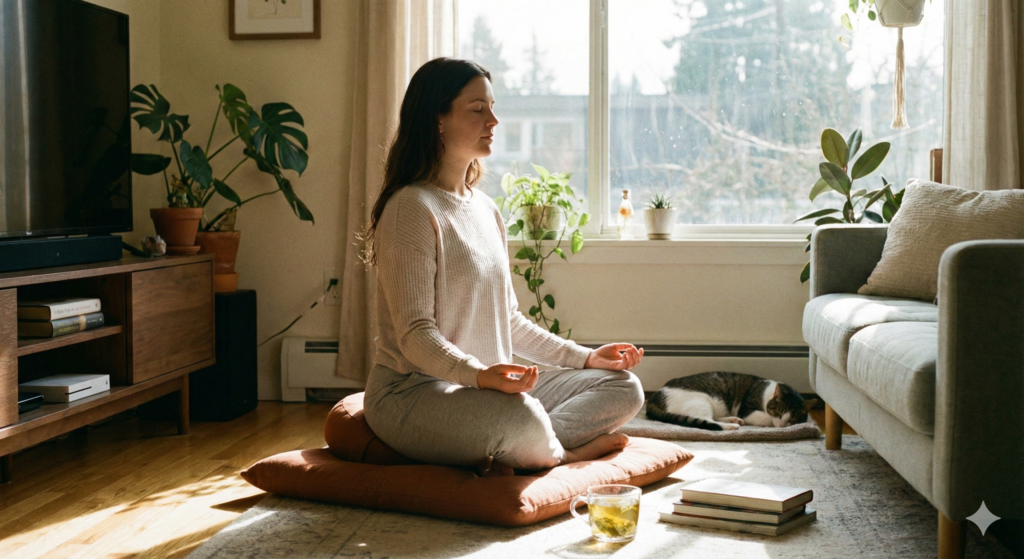
Sit in a comfortable position — cross-legged on a mat or upright on a chair. Keep your spine erect but not rigid, as if your head were gently lifted by an invisible thread. Hands may rest on the knees or in your lap.
A steady posture communicates safety to the nervous system, allowing attention to turn inward.
2. Breathing: The Gateway to Awareness
Start with a few deep breaths to settle. Then observe your natural rhythm — the rise and fall of the belly, the soft whisper of air.
You can explore:
Diaphragmatic Breathing – deep, slow breaths that relax the body.
Box Breathing (4-4-4-4) – inhale 4, hold 4, exhale 4, hold 4.
Alternate Nostril Breathing (Nadi Shodhana) – balances both brain hemispheres and calms emotions.
As the breath steadies, so does the mind.
3. Dharana to Dhyana
Begin with Dharana — focus on one point (the breath, a mantra, or a candle flame). As concentration deepens, release effort and allow awareness to expand naturally into Dhyana.
4. Daily Integration
Practice 10–15 minutes daily. Over time, mindfulness will spill into ordinary life — walking, speaking, even listening. Every moment can become meditation in motion.
5. The Gentle Return
If distraction arises, smile and return to awareness. Each return is not a failure, but a refinement of presence.
These simple steps, practiced sincerely, prepare the mind for deeper stillness. Dhyana is not an achievement but a surrender — the quiet unfolding of awareness into itself.
As you dive deeper into Dhyana, you begin to see that silence is not empty — it’s full of knowing. Stillness is not passive — it’s alive with awareness.
The mind, once restless, starts to trust the quiet. Thoughts lose their sharpness. Emotions soften. You begin to perceive life not as a series of problems to solve, but as an experience to witness.
This is the beauty of Dhyana: it transforms your relationship with reality. You no longer chase peace; you rest in it. You no longer try to control the moment; you live through it.
As the Mandukya Upanishad declares: “That which is unseen, ungrasped, beyond all thought — that is peace, that is the Self.”
True meditation reveals that the peace you seek is not something you acquire — it is what you are when all else falls silent.
So, as you finish reading, take a slow, conscious breath. Feel it enter and leave. Notice the stillness between the two. That quiet pause — that’s Dhyana. That’s your true home.
Dive there often.