Across India’s spiritual heritage, Dhyana has been revered as the path to the Self (Atman), the realization that beneath all movement, awareness remains untouched.
Vedic and Yogic Dhyana
In the Upanishads, meditation is the meeting point between the finite and the infinite. The Chandogya Upanishad declares: “Where the mind is established in silence, there the Self reveals itself.”
Patanjali’s Yoga Sutras build upon this, offering Dhyana as the bridge between effort and grace — where individual consciousness (Jiva) merges with universal consciousness (Brahman).
Buddhist Jhana
In Buddhism, Dhyana (Jhana) unfolds in four progressive stages. The first calms the mind; the second brings joy and inner light; the third deepens equanimity; and the fourth rests in pure awareness beyond pleasure or pain. From here, insight (Vipassana) arises naturally.
Zen and Chan Traditions
As Dhyana spread eastward, it evolved into Chan (China) and Zen (Japan). These schools emphasize simplicity — “just sitting” (Shikantaza) or meditating on koans, paradoxical questions that dissolve logical thinking and reveal direct experience of truth.
Bhakti and Mantra Meditation
In Hindu devotional paths, Dhyana often takes the form of mantra repetition (Japa), focusing the mind on divine sound. The rhythm of chanting harmonizes breath and heart, leading to deep meditative absorption.
Though diverse in form, all styles share the same destination — the dissolution of the fragmented mind into the wholeness of awareness. Whether through silence, sound, focus, or love, Dhyana returns us to harmony with life itself.
Here are six accessible Dhyana styles you can explore to discover what resonates most deeply with your nature.
1. Breath-Focused Dhyana (Anapanasati)
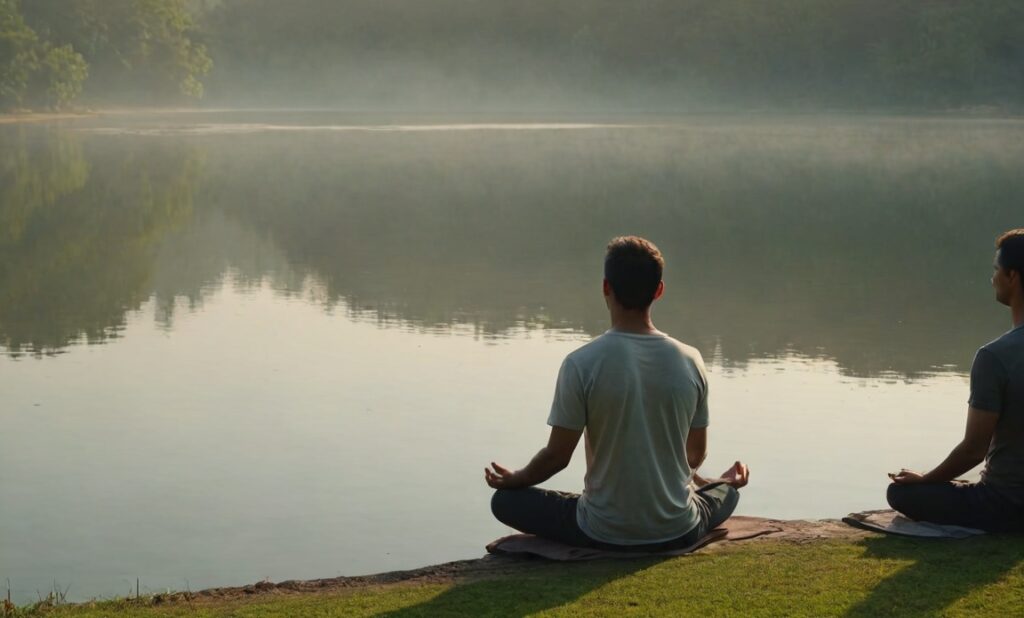
Sit comfortably, close your eyes, and focus on the natural flow of breath. Notice its rhythm, its pauses. Each time the mind wanders, return to the breath gently. This practice anchors awareness in the present moment.
2. Mantra Dhyana (Japa Meditation)
Choose a mantra such as Om, So Hum, or Om Shanti. Repeat it silently or aloud. Let the sound vibrate through your awareness. The mantra becomes a bridge between thought and silence.
3. Loving-Kindness Dhyana (Metta Bhavana)
Bring to mind yourself, loved ones, and all beings. Silently repeat: “May all be peaceful, may all be free.” This opens the heart and reduces emotional tension.
4. Guided Visualization Dhyana
Imagine a serene place — a mountain, forest, or river. Engage all senses to make it vivid. Visualization reduces stress and trains the mind to find calm through imagery.
5. Self-Inquiry Dhyana (Atma Vichara)
Popularized by Ramana Maharshi, this practice involves asking, “Who am I?” Each time a thought arises, return to the silent awareness from which it came. This inquiry reveals the witness behind the mind.
6. Walking or Movement Dhyana
Mindful walking, Tai Chi, or slow yoga can also be meditative when done with full awareness. Every step, every movement becomes a prayer in motion.
You don’t need to practice all these styles. Explore, experiment, and observe what feels most natural. Your body, breath, and intuition will guide you toward your personal form of harmony.
Meditation, in all its styles, ultimately points to one truth — peace is not something we find outside; it’s something we uncover within.
When you explore different Dhyana methods, you’re really exploring yourself — your rhythms, your resistances, your stillness. Each technique is a mirror reflecting a different facet of your awareness.
With time, you’ll notice that the boundaries between styles begin to blur. The breath, the mantra, the silence — all merge into one seamless field of presence. That is true Dhyana — awareness resting in awareness.
The Gita teaches a powerful truth — when we learn to guide our own mind, it supports us like a loyal companion. But when we lose that inner control, the same mind can turn against us.
Through meditation, that noisy inner turbulence slowly settles. What once felt like chaos becomes open and calm — a clear inner space that walks with you, not against you, on the journey toward peace.
Remember, Dhyana is not about perfection or performance. Some days your practice will feel deep; other days distracted. What matters is sincerity. Each moment of mindfulness is a drop contributing to the ocean of peace within you.
So today, take a breath — not to control it, but to feel it. Notice the space between inhale and exhale. That quiet pause is your center, your balance, your harmony.
And from that still center, life flows effortlessly.