
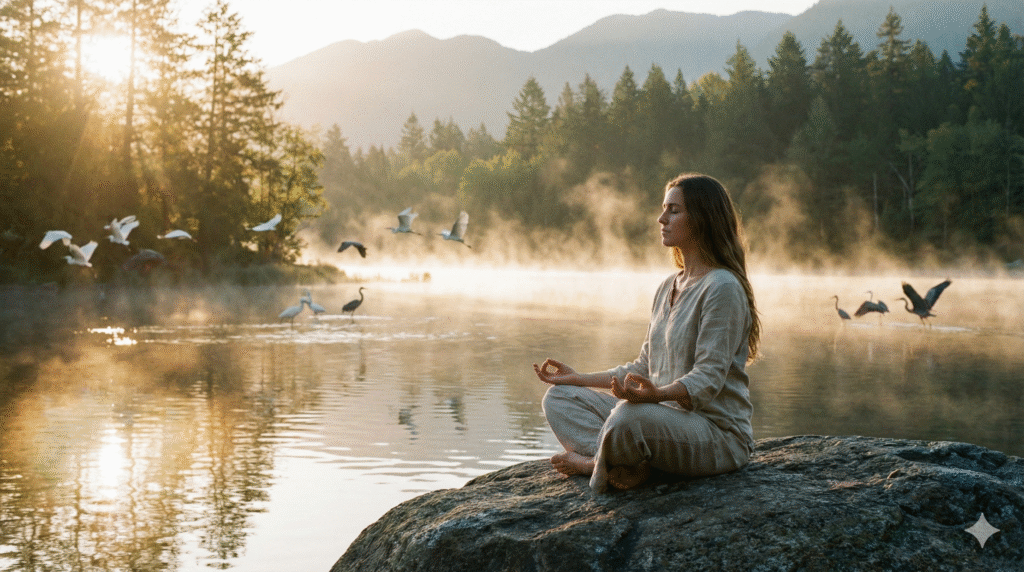
There is a certain kind of peace that cannot be forced — the peace that arises when you stop chasing it. Maybe you’ve felt it before: that stillness that appears when you watch the rain fall, listen to gentle waves, or breathe deeply after a long day. For a brief moment, you’re fully here. Not remembering, not anticipating — simply being.
That fleeting sense of presence is what mindfulness meditation cultivates — a way of living that brings the scattered pieces of life back into one clear, grounded awareness.
In our restless world, the mind rarely pauses. It jumps between screens, conversations, and obligations, leaving us drained yet unsatisfied. We think peace will come after the next task, the next goal, the next weekend. But tranquility doesn’t wait at the finish line — it exists right now, hidden in this very breath.
Mindfulness meditation teaches us to rediscover that truth — to inhabit the present moment fully, without judgment or resistance. It’s not about withdrawing from life, but awakening to it.
The Buddha described mindfulness (Sati) as “the path to the deathless,” meaning the path beyond constant mental noise and emotional reactivity. Modern psychology echoes this wisdom: mindfulness retrains the brain to move from autopilot to conscious presence, reducing anxiety, stress, and rumination.
In the end, mindfulness isn’t something we add to our lives; it’s something we remember. It’s the natural clarity beneath the clutter — the quiet awareness that watches everything unfold, untouched and steady.
This article invites you to explore mindfulness not as a technique, but as a way of being — a doorway to tranquility that’s been within you all along.
At its heart, mindfulness meditation is the practice of paying attention deliberately and non-judgmentally to the present moment. The term comes from the Pali word Sati, meaning awareness, remembrance, or attention.
The Buddha taught mindfulness as part of the Eightfold Path, a foundation for ending suffering by awakening wisdom and compassion. In modern times, psychologists like Jon Kabat-Zinn have brought mindfulness into medicine and therapy, developing Mindfulness-Based Stress Reduction (MBSR) to help people cope with pain, anxiety, and burnout.
So, what happens when we meditate mindfully?
When you focus on your breath, sensations, or thoughts without reacting, the amygdala (the brain’s fear center) begins to calm down. Simultaneously, the prefrontal cortex, associated with reasoning and emotional control, becomes more active. Over time, this rewiring reduces automatic stress responses and cultivates emotional stability.
Mindfulness also improves neuroplasticity — the brain’s ability to reorganize itself. Studies show that regular practice strengthens areas linked to empathy, focus, and memory. Even eight weeks of consistent meditation can measurably thicken the hippocampus, the region associated with learning and self-awareness.
But beyond the science, mindfulness is a spiritual practice of seeing clearly. It reveals that peace doesn’t depend on fixing external conditions — it arises when you stop identifying with every thought and emotion that passes through your awareness.
You begin to understand: you are not your thoughts; you are the space in which they appear.
That shift — from being lost in thinking to witnessing it — is where tranquility begins.
When we first begin practicing mindfulness meditation, we quickly encounter the restless mind. Thoughts swarm like bees: unfinished tasks, random memories, self-criticism. It’s easy to think, I can’t do this. My mind won’t stop.
But mindfulness isn’t about stopping thoughts — it’s about changing our relationship with them.
The mind’s restlessness is natural. For years, we’ve trained it to chase, to compare, to anticipate. Sitting still interrupts that momentum. The discomfort we feel in meditation isn’t failure; it’s awareness waking up to the habits of the mind.
There’s also an emotional layer. When silence deepens, we begin to meet ourselves — the griefs, insecurities, and old wounds we’ve distracted ourselves from. The practice asks for courage — to face what arises with gentleness rather than judgment.
Modern psychology explains this through exposure and acceptance: mindfulness helps us tolerate discomfort without avoidance. Over time, this reconditions the nervous system to remain calm even in stress.
The Buddhist tradition frames this as Vipassana, insight — seeing things as they are, not as we wish them to be. The mind learns to let go.
You might feel, at times, like you’re not progressing. But every moment of awareness — every time you notice you’ve drifted and gently return — is progress. The key is not perfection, but persistence.
Mindfulness grows like a muscle — through patient, consistent practice. Each moment of noticing strengthens tranquility from within.
Mindfulness is ancient — older than religion, as natural as breath itself. The Buddha called it Satipatthana, the four foundations of awareness:
Awareness of the body (Kaya)
Awareness of feelings (Vedana)
Awareness of thoughts and mind (Citta)
Awareness of reality as it is (Dhamma)
Each layer leads deeper into clarity. By observing body sensations, we ground ourselves in the present. By observing feelings, we learn non-reactivity. By observing thoughts, we loosen the illusion of self.
Indian philosophy offers a parallel in Dhyana — the meditative absorption described in the Yoga Sutras. Patanjali taught that when mental fluctuations cease (Chitta vritti nirodhah), the Self (Purusha) shines in its true form — pure consciousness.
Both teachings point to the same essence: mindfulness as a return to our natural awareness, uncolored by attachment or aversion.
In Hindu and Buddhist imagery, this awareness is like the still lake that reflects the moon perfectly when undisturbed. When the surface ripples with thought, the reflection blurs. But the moon — awareness itself — never changes.
Modern mindfulness programs like MBSR are, in truth, echoes of these timeless insights. What ancient sages discovered through introspection, science now confirms through neurobiology: stillness heals.
Thus, mindfulness is not about withdrawal from the world — it is a sacred participation in it, lived through presence. Every act — breathing, listening, walking — becomes a meditation when awareness infuses it.
That is the quiet revolution of mindfulness: not changing life, but changing the way we meet it.
Here are some accessible ways to begin cultivating mindfulness and tranquility in your daily life.
1. The Mindful Breath
Sit comfortably with your spine upright. Let your shoulders relax.
Observe the natural rhythm of your breath — the cool inhale, the warm exhale.
When your mind drifts, simply notice and return to the breath.
This simple act retrains your focus and activates the parasympathetic nervous system — the body’s relaxation response.
2. Body Awareness Meditation
Bring attention to physical sensations — the weight of your body, the texture beneath you, the rise and fall of your chest.
This grounds awareness in the present and reduces anxiety by shifting focus from thought to sensation.
3. Mindful Breathing Variations
Explore gentle Pranayama-inspired breathing:
Box Breathing (4-4-4-4): Inhale 4, hold 4, exhale 4, hold 4 — balances calm and focus. Diaphragmatic Breathing: Deep belly breaths to slow the heartbeat and release tension. Alternate Nostril Breathing (Nadi Shodhana): Harmonizes brain hemispheres and steadies emotions.
4. Everyday Mindfulness Choose one daily activity — eating, walking, or washing hands — to do with full attention. Notice textures, smells, sounds. Bring awareness back each time it wanders.
5. Loving-Kindness (Metta) Meditation
End your practice by silently offering kindness:
“May I be peaceful.
May I be free from fear.
May all beings be peaceful.”
This simple ritual expands compassion — a natural companion of tranquility.
Practice daily for even 10 minutes. Over weeks, mindfulness becomes less something you do and more something you are.
Tranquility doesn’t come from escaping life but from embracing it with full awareness. Mindfulness meditation teaches us to meet each moment — pleasant or painful — with the same open heart.
When awareness grows, we stop reacting and start responding. We stop identifying with every thought and begin to rest in the spaciousness behind it. This is true freedom — the mind at ease within itself.
Over time, mindfulness becomes a quiet companion. Stressful events still occur, emotions still arise, but you remain anchored — like the ocean beneath its waves.
Science can measure mindfulness’s impact on the brain, but only experience can reveal its fragrance — that deep, wordless peace of simply being.
So, as you end this reading, take a slow breath. Feel it enter your body, then leave. That breath is life itself, happening now — simple, sacred, sufficient.
The path to tranquility begins right here, in this moment of awareness. All you have to do is notice.