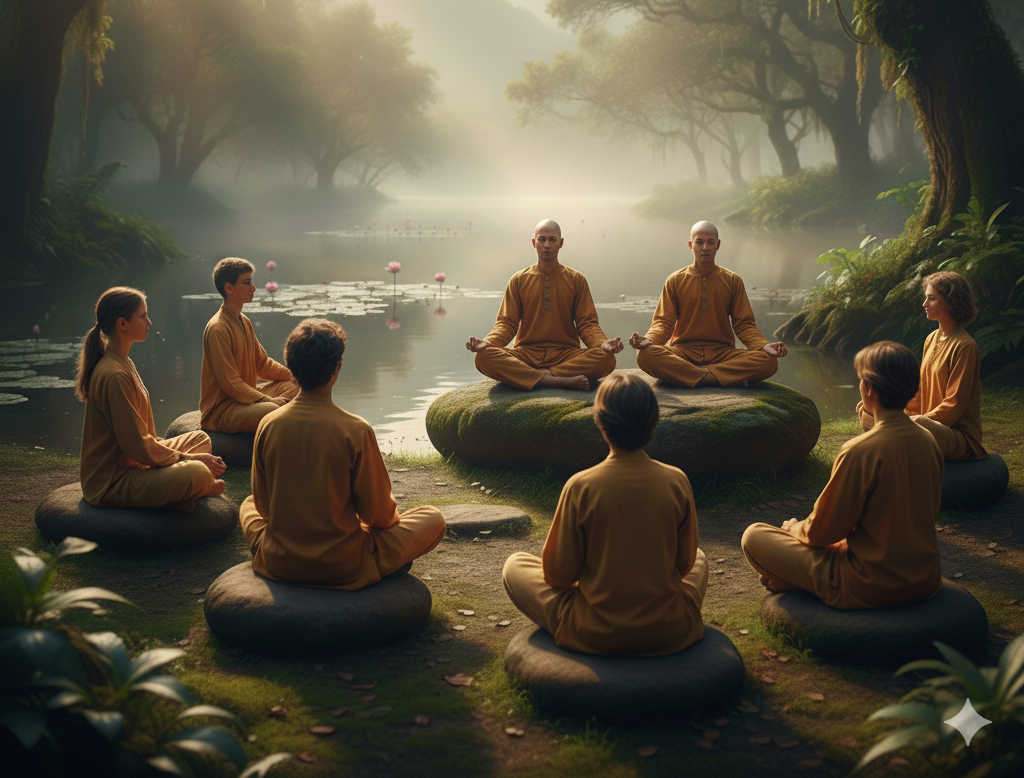
We often think serenity is something we must travel far to find — hidden in mountains, monasteries, or retreats. Yet, every once in a while, amid the ordinary flow of life, there comes a moment of stillness. Maybe it happens while watching the sunset, or while breathing deeply after a long day. For a few precious seconds, everything stops — and peace reveals itself from within.
That moment is meditation.
In our modern world, meditation is surrounded by myths. Some imagine it as a mystical escape, others as a difficult practice reserved for monks. In truth, meditation is simple — but not easy. It is the art of returning to yourself, again and again, through breath, body, and awareness.
When we sit in meditation, we are not trying to become something new; we are learning to rest in what we already are — awareness itself. Yet this simplicity is often lost because our restless minds seek instant results. We chase techniques, timing, or exotic methods, forgetting that peace is not created by effort; it is uncovered through surrender.
Meditation is not about stopping thoughts; it’s about observing them without being caught. It’s a gentle unlearning — of noise, of hurry, of constant striving. When you sit with an open heart and attentive breath, serenity begins to unfold naturally.
This article will walk you through the truth of meditation — stripped of mysticism, rooted in both science and tradition. We will explore how posture shapes your state of mind, how breathing regulates your inner world, and how awareness blossoms when body and breath work together.
Because serenity is not something to achieve — it’s something to allow.
Meditation, in its purest sense, is awareness — the conscious presence that observes without judgment. In Sanskrit, it is called Dhyana, a state where attention flows effortlessly toward one point, ultimately merging with pure consciousness.
From a modern perspective, meditation is both a psychological and physiological process. When practiced regularly, it reduces activity in the brain’s default mode network (DMN) — the system responsible for mind-wandering and self-referential thoughts. Simultaneously, it enhances regions responsible for focus, empathy, and emotional balance.
But meditation is not merely a mental exercise. It’s a whole-body experience, where breath, posture, and attention form a living triangle of awareness.
Posture (Asana) keeps the body still yet alert, signaling safety to the nervous system.
Breath (Pranayama) bridges the body and mind, directly influencing the heartbeat, emotions, and mental clarity.
Awareness (Dhyana) unites both, allowing consciousness to expand beyond the boundaries of thought.
Meditation is not limited to sitting cross-legged or chanting mantras. It can be practiced while walking, eating, or simply breathing consciously. What matters is presence.
Think of meditation as tuning an instrument — your body is the instrument, the breath is the string, and awareness is the melody. When these three align, serenity becomes not an act, but a natural vibration of your being.
Every beginner faces a common challenge — the restless mind. The moment we sit, thoughts multiply. Plans, memories, worries all rush in like uninvited guests. This can feel discouraging, but it’s completely natural.
Our brains have been conditioned for constant stimulation. The prefrontal cortex seeks novelty, and the dopamine system craves reward. When you ask the mind to be still, it protests — not because you are failing, but because stillness is unfamiliar.
Ancient yogis called this turbulence chitta vritti — the “fluctuations of the mind.” The purpose of meditation is not to destroy these waves but to observe them until they calm themselves.
The struggle also reveals how disconnected we are from our bodies. Many try to meditate with tense shoulders, shallow breaths, or slouched posture. The body, uncomfortable, sends distress signals to the mind, making stillness even harder.
That is why posture and breath are not optional — they are foundational. When your spine is aligned and your breath is deep, the mind begins to follow the rhythm of the body. Relaxation becomes physiological, not forced.
Remember: the inner struggle is not an obstacle but the path itself. Each distraction teaches patience. Each return to the breath is a small awakening. The key is gentleness. You are not taming the mind; you are befriending it.
As thoughts rise, simply watch. As tension appears, breathe into it. The peace you seek is not beyond the noise — it’s hidden within it.
Long before brain scans and wellness apps, meditation was understood as a sacred science. The Yoga Sutras of Patanjali describe it as the gradual stilling of the mind (Yoga chitta vritti nirodhah). When the mind becomes clear, the Self reveals itself as pure consciousness — Purusha.
The Upanishads spoke of this same inner state, where awareness merges with the infinite: “As a lamp does not flicker in a windless place, so the yogi’s mind remains steady in meditation.”
For ancient yogis, posture and breath were not technicalities but sacred tools.
The spine was seen as the sushumna nadi, the central energy channel through which awareness ascends. Sitting upright aligned this flow.
The breath, or prana, was the vehicle of consciousness — the subtle bridge between body and spirit.
This philosophy recognized that body, breath, and consciousness are not separate — they mirror one another. When the breath is calm, the mind becomes calm; when posture is stable, awareness deepens.
Modern science now echoes this understanding. Studies show that upright posture increases alertness, while diaphragmatic breathing activates the parasympathetic (rest-and-digest) response. What yogis intuited centuries ago, neuroscience now confirms: how you sit and how you breathe shape how you think and feel.
Thus, the ancient art of meditation was never escapism; it was alignment — of posture, breath, and presence — to awaken serenity within.
To truly experience meditation, we must return to the body and breath — the twin gateways to awareness. Here’s how:
 1. Posture: The Silent Foundation
Settle into a posture that feels both comfortable and awake — maybe sitting cross-legged on the floor or upright in a chair with your feet grounded. Keep your spine straight but not stiff, as if a soft thread is gently drawing the top of your head upward. Let your hands rest naturally on your knees or in your lap, and close your eyes with ease.
When your body feels steady and supported, it sends a signal of safety to your nervous system, helping your mind relax and your awareness grow quietly deeper.
 2. Breathing: The Bridge Between Worlds
Breath is the first teacher. Below are three gentle Pranayama styles you can explore:
Diaphragmatic (Deep Belly) Breathing: Breathe slowly into your abdomen. This reduces heart rate and signals relaxation.
Box Breathing (4-4-4-4): Inhale for 4 counts, hold for 4, exhale for 4, hold for 4. This balances energy and focus.
Alternate Nostril Breathing (Nadi Shodhana): Inhale through one nostril, exhale through the other, alternating. This harmonizes the brain hemispheres and calms emotions.
Begin with 5 minutes daily. As you breathe, observe sensations without judgment.
 3. Awareness: The Gentle Observer
After settling the breath, let awareness expand. Watch thoughts arise and dissolve. Return to the breath whenever you drift. This movement between focus and freedom is meditation.
 4. Integration: Living Meditation
Carry this presence into daily life — eating, walking, or listening. Every act done with awareness becomes a prayer.
With time, you’ll realize meditation is not an activity but a state — a way of being anchored, awake, and free.
Meditation demystified is meditation understood as simplicity. No rituals, no labels — just the pure art of being. The more you practice, the more you see that serenity isn’t somewhere you arrive; it’s what remains when you stop running.
When posture is aligned, breath steady, and awareness open, something miraculous happens. The chatter softens. The body feels light, the mind clear. You begin to sense a quiet joy that doesn’t depend on circumstance — a peace that holds even the storms gently.
Remember, progress in meditation is not measured in stillness but in awareness. If you can notice a thought instead of being carried by it, you are already meditating.
As you end each session, rest a moment in gratitude — for the breath that sustains you, for the stillness that reveals you.
Ask yourself: What if serenity was never lost — only waiting to be noticed?
In that single question lies the heart of all meditation.
So, take a deep breath now. Feel it move through your body like a wave of calm. Straighten your spine, soften your shoulders, and let awareness settle like dust in sunlight. That’s it. You’ve just touched the essence of meditation — simple, silent, infinite.